Disciplined Capital Allocation, Buybacks, and Activist Defense
A systematic framework for allocating free cash flow, executing share
Líder en desarrollo web, e-learning & redes sociales

For executive leadership and board members, analyzing quarterly earnings reports from major technology firms is far more than an exercise in stock market observation. The true strategic value lies in extracting the operational lessons market giants are experiencing at scale and applying them to broader corporate governance today.
Wall Street has fundamentally shifted away from rewarding abstract technological promises. Pressure on technology leaders now centers squarely on strict Return on Investment (ROI) monitoring, effective monetization of Artificial Intelligence infrastructure, and disciplined operational expenditure.
Any organization currently reviewing its digital transformation budget should analyze four key strategic imperatives derived from current Big Tech performance.
In prior quarters, financial markets tolerated massive increases in Capital Expenditure (CapEx) allocated toward AI infrastructure, data centers, and raw compute capacity. Today, that narrative has shifted dramatically.
The CapEx-to-Monetization Gap: Firms that continue to accelerate AI capital spending without demonstrating correlative operational revenue growth face immediate valuation pressure.
Focus on Measurable Productivity: Enterprise buyers are no longer funding proof-of-concept (PoC) experiments; they demand AI tools that verifiably reduce customer acquisition costs or measurably enhance workforce output.
Executive Action: Halt AI initiatives that lack direct financial impact metrics. Require your technology leadership (CIO/CTO) to ensure every investment in automation or generative AI software carries a clear payback period of 12 months or less.
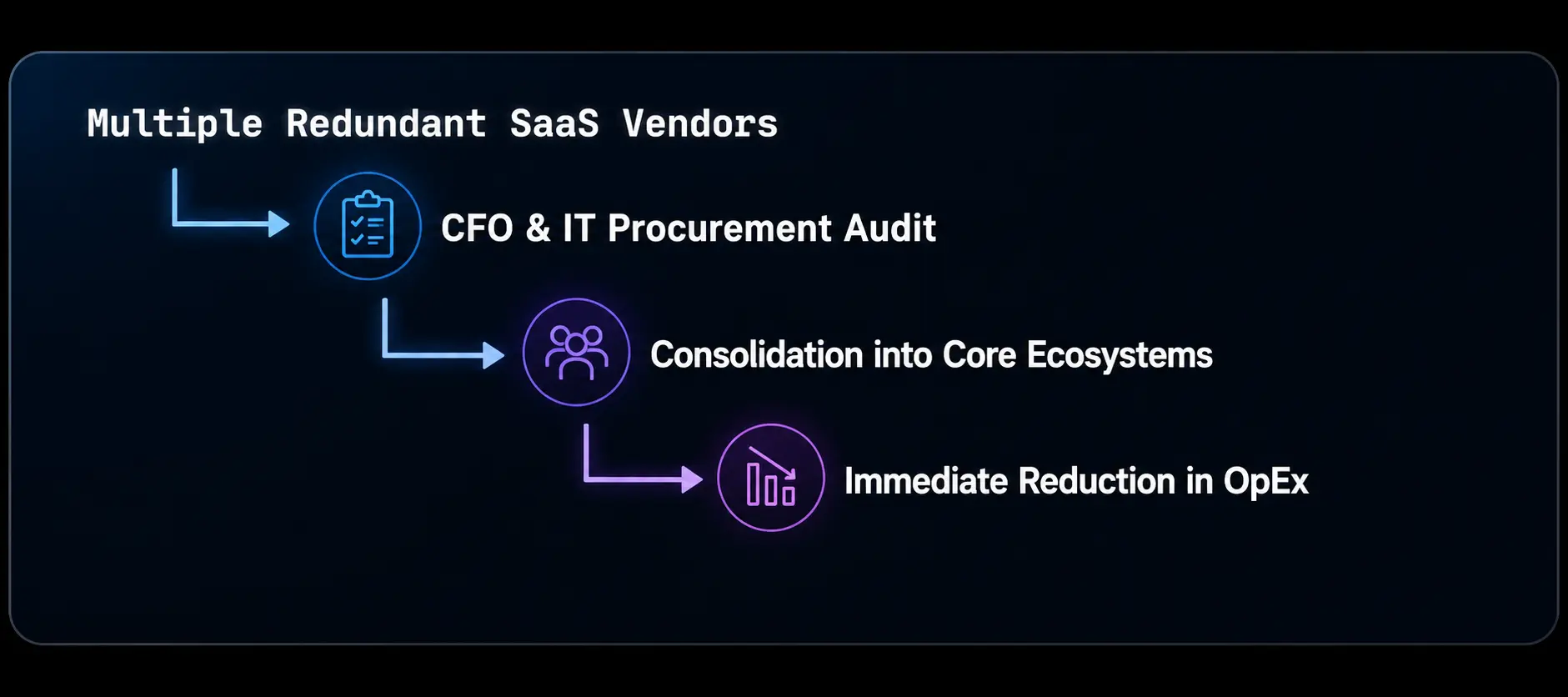
Recent financial results across enterprise software vendors highlight a clear structural trend: corporate clients are aggressively reducing vendor counts and consolidating software licenses under unified ecosystems.
End of Unchecked Tool Proliferation: The era of individual departments independently procuring specialized SaaS tools is over. CFOs are forcing enterprise-wide stack consolidation.
Pricing Power Concentrated at the Core: Only platform solutions that serve as the operational backbone of the business (core ERP and CRM engines) retain true pricing power without risking churn.
Executive Action: Initiate an immediate audit of software licensing across all business units. Eliminate redundant tools and leverage your total spend with primary strategic vendors to negotiate volume discounts and multi-year contractual terms.
One of the most profound takeaways from recent tech sector performance is that corporate restructuring and headcount rationalization were not temporary emergency measures—they represented a permanent structural shift toward margin discipline.
Higher Operating Margins with Leaner Teams: Tech giants have demonstrated that it is entirely possible to maintain or accelerate top-line revenue growth while structurally lowering G&A overhead.
Rigorous Resource Allocation: Secondary or speculative projects are systematically closed to redirect capital toward the profitable core business.
Executive Action: Adopt a Zero-Based Budgeting mindset for operating expenses in the upcoming planning cycle. Do not approve headcount additions based on growth inertia; require internal resource reallocation before authorizing new hires.
The era of “blind cloud migration” has concluded. Growth metrics across cloud infrastructure providers reflect that the primary mandate for enterprise clients is Cloud Cost Optimization (FinOps).
Hybrid Workload Deployment: Organizations are actively repatriating select critical workloads to private infrastructure or dedicated hardware when public cloud scaling costs prove inefficient.
Real-Time Infrastructure Governance: Cloud management has evolved from a technical task into a critical budget control metric for executive finance teams.
Executive Action: Formalize FinOps practices within your IT governance framework. Establish automated spending alerts and demand monthly executive reviews on cloud consumption to eliminate budget overruns before they occur.
Current Big Tech performance sends an unequivocal signal to the broader corporate world: technology spending is no longer a blank check written on future expectations. Winning business leaders will be those who apply the same financial rigor to their tech stack as they do to any major capital investment, insisting on operational efficiency, software consolidation, and measurable ROI.

A systematic framework for allocating free cash flow, executing share

For expanding multinational enterprises, global growth often triggers a silent

For high-growth ventures and mid-market enterprises, scaling successfully involves more

A strategic approach to leveraging direct lending solutions while mitigating