Strategic Insights: Growth & Capital

High-level analysis to multiply your money and scale your business

Beyond Policy Predictions: Corporate Capital Strategy in the Federal Reserve’s High-Rate Era

For executive leadership and Chief Financial Officers (CFOs), speculating on the exact timing of Federal Reserve interest rate adjustments or parsing the subtle shifts in central bank language is a secondary exercise. The true strategic mandate is not predicting central bank policy—it is actively managing the operational and structural impact that current monetary policy exerts on corporate capital, project valuations, and balance sheet resilience.

With the federal funds rate remaining in restrictive territory to firmly anchor inflation expectations, corporate leaders are operating under a “higher for longer” baseline. This environment fundamentally reshapes hurdle rates, debt refinancing schedules, and corporate liquidity management.

To protect shareholder value and maintain strategic agility, executive teams must execute on four critical operational fronts.

Recalibrating CapEx Hurdle Rates Against Today's Cost of Capital

For over a decade, corporate investment models operated on assumptions of ultra-low Weighted Average Cost of Capital (WACC). With benchmark rates remaining high, the risk-free rate underlying all corporate valuation models has shifted permanently upward.

  • The Risk of Capital Erosion: Approving automation, expansion, or technology projects using outdated discount rates creates a false sense of profitability while actively eroding enterprise value.

  • Competing Against Risk-Free Yields: Every capital deployment project now directly competes with the high risk-free returns available in short-term yield instruments.

Executive Action: Re-evaluate all pending CapEx proposals by increasing hurdle rates by 200 to 300 basis points over historical averages. Demand that Free Cash Flow (FCF) models demonstrate resilience under stressed scenarios without relying on anticipated credit easing.

Managing Debt Maturity Walls and Fixed-Rate Conversions

The Fed’s policy stance impacts different segments of the yield curve unevenly. Carrying floating-rate corporate debt in this environment subjects income statements to unnecessary margin volatility and unpredictable interest expense spikes.

  1. The Cost of Waiting: Many corporate treasuries postponed long-term refinancing in hopes of swift rate cuts. This strategy significantly increases refinancing risk as debt maturity walls approach.

  2. Expanding Credit Spreads: Risk premiums demanded by commercial lenders and bond markets add to the Fed’s baseline rate, compounding the real cost of corporate borrowing.

Executive Action: Execute proactive liability management. Transition floating-rate exposure into fixed-rate structures or utilize interest rate swaps to lock in borrowing costs over the next 18 to 24 months, securing predictable debt service requirements.

Navigating the Silent Commercial Credit Tightening

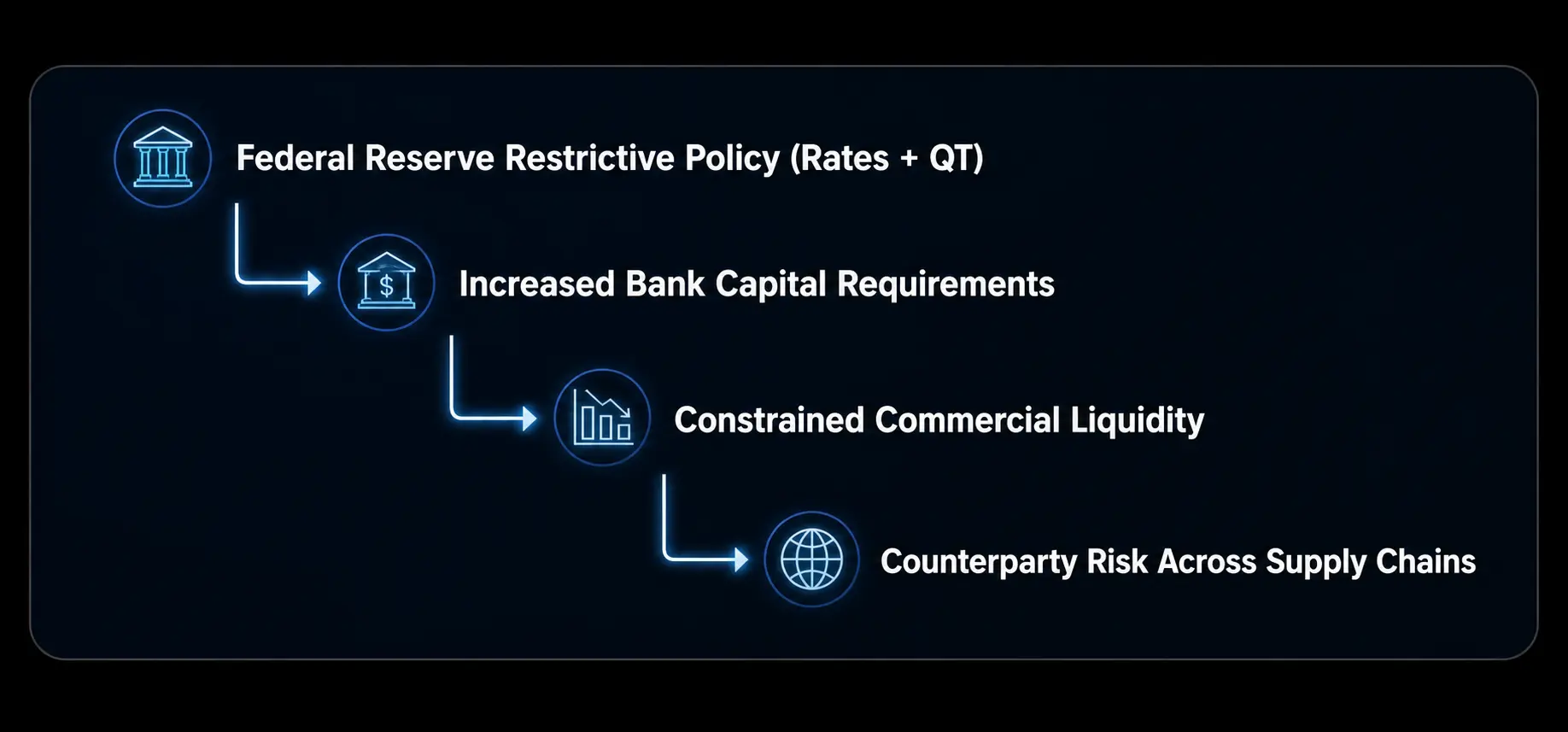
The Fed’s policy impacts not only the price of money (interest rates), but its overall availability. Elevated rates combined with quantitative tightening (balance sheet reduction) continue to place capital pressure on commercial banks.

  • Tightening Lending Standards: Banks are actively reducing unused lines of credit, increasing collateral demands, and enforcing stricter Debt Service Coverage Ratios (DSCR).

  • Supply Chain Vulnerability: Mid-tier and smaller vendors across your supply chain face severe credit constraints, creating hidden operational risk for prime contractors.

Executive Action: Diversify corporate liquidity sources. Reduce reliance on traditional revolving bank lines by exploring vendor financing arrangements, commercial paper issuance, or strategic private credit partnerships to guarantee operational liquidity.

Transforming Corporate Treasury from a Cost Center to a Yield Driver

In a zero-interest-rate environment, corporate treasury functions primarily focused on minimizing banking fees. Today, leaving idle cash in non-interest-bearing operating accounts incurs a severe and direct opportunity cost.

  • Passive Cash Erosion: Uninvested operating cash degrades relative to the corporate cost of capital. Active cash management can generate substantial yields via low-risk money market funds or short-term Treasury bills.

  • Asymmetric Working Capital Management: While operating cash generates yield, optimizing Days Payable Outstanding (DPO) further enhances the company’s net financial return.

Executive Action: Redesign corporate cash sweep mechanisms. Establish strict operational cash buffer thresholds and automatically sweep excess daily balances into liquid, yield-generating instruments linked directly to current benchmark rates.

Federal Reserve monetary policy is an operational framework that dictates the rules of corporate finance today. Executive leaders who successfully navigate this cycle will be those who stop waiting for a return to cheap capital and instead aggressively adjust their CapEx hurdle rates, debt structures, and treasury yield strategies.

Most read by fellow executives