Maximizing Corporate Cash Flow: Next-Gen FinTech Tools for Automated Asset Management
In high-growth corporate ecosystems, liquidity architecture dictates the speed of
Líder en desarrollo web, e-learning & redes sociales

In today’s US corporate environment, endlessly debating headline inflation (CPI) or speculating on the exact pace of Federal Reserve rate cuts is a costly distraction. For executive leadership and Chief Financial Officers (CFOs), the real challenge is not macroeconomic theory—it is operational execution in the face of a sticky inflation regime that quietly erodes margins and distorts Free Cash Flow (FCF).
Today, corporate leaders face a business reality where fixed overhead remains stubbornly high, the cost of capital stays elevated for longer, and buyer behavior has fragmented.
To protect enterprise value, executive leadership must refocus capital allocation across four critical operational fronts.
While goods and physical input inflation have shown signs of stabilization due to supply chain normalization, corporate service sector inflation (“Supercore Inflation”) remains extremely rigid.
EBITDA margins are no longer being compressed by raw material costs, but rather by sustained, structural pressure within General and Administrative (G&A) overhead:
Corporate Health & Benefits: Employer healthcare insurance premiums across the US continue to register double-digit annual increases.
Key Talent Retention: While mass hiring has slowed, compensation costs for specialized technical and strategic roles remain under upward pressure.
Insurance & Professional Services: Premiums for corporate liability, cybersecurity coverage, and external auditing have adjusted upwards to a higher structural baseline.
Executive Action: Conduct a replacement-cost audit on all B2B service vendor contracts. Stop budgeting renewals based on historical CPI; renegotiate terms directly tied to performance SLAs and operational efficiency metrics.
For over a decade, capital allocation strategies in the US were built on the assumption of cheap debt. Many organizations are still operating with corporate bond issuances or credit lines secured at 3% to 4% coupons.
As these instruments mature, refinancing at current market rates (7%–9%) creates an immediate cash flow shock:
The Accounting Profitability Illusion: Historical-cost accounting under US GAAP may show a healthy operating margin, but soaring debt service costs absorb net liquidity.
CapEx Impairment: Expansion or infrastructure projects approved under zero-interest-rate policies lose their Net Present Value (NPV) when recalculated against today’s Weighted Average Cost of Capital (WACC).
Executive Action: Run a 24-month debt maturity stress test on your liquidity. Prioritize paying down high-cost liabilities or restructuring into fixed-rate instruments before authorizing share buybacks or extraordinary dividend distributions.
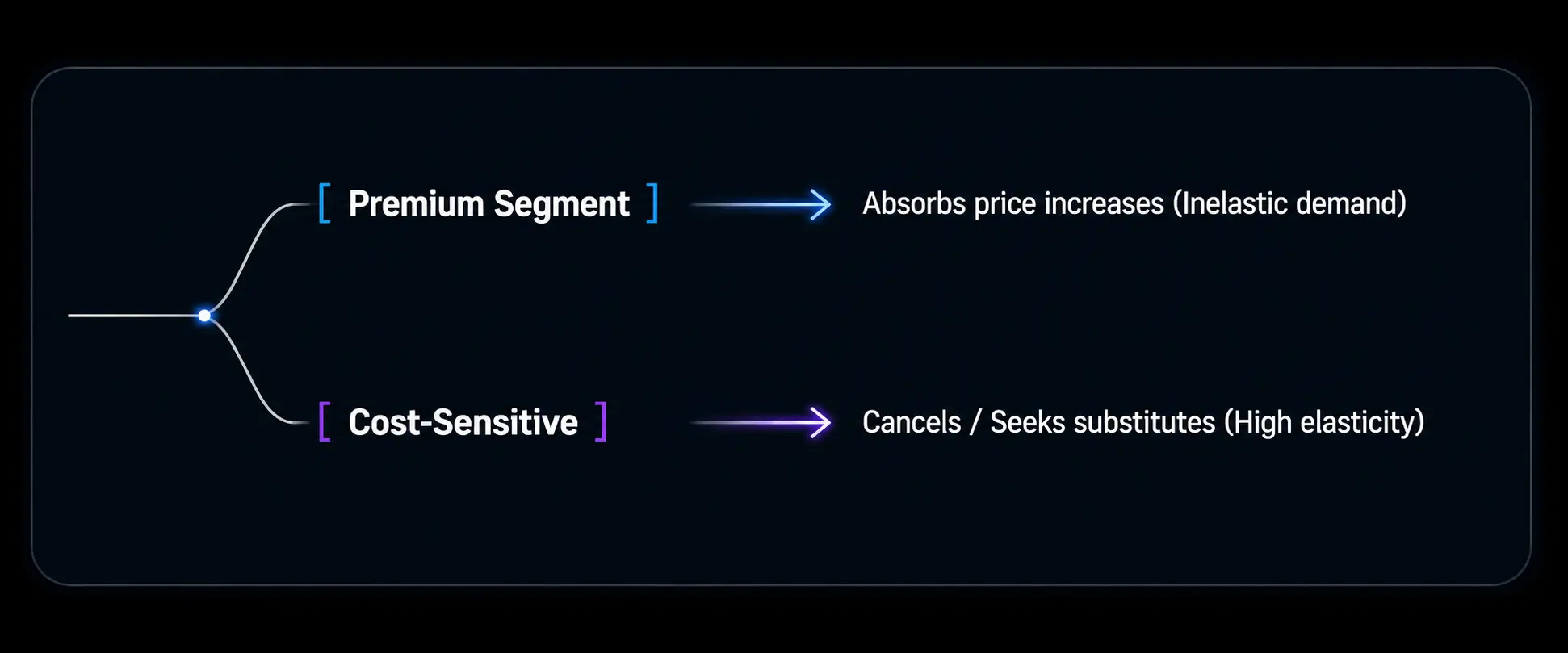
Applying across-the-board price hikes (e.g., a blanket “+5% across all SKUs”) to offset cost inflation is a dangerous tactical error in today’s market. US demand has split into a distinct K-shaped pattern:
The Premium / High-Value Segment: Absorbs price adjustments with low elasticity, prioritizing service continuity, reliability, and brand equity.
The Cost-Sensitive Segment: Exhibits extreme resistance, actively migrating to cheaper alternatives or cancelling discretionary contracts at the slightest price increase.
Executive Action: Abandon linear pricing structures. Transition to a Targeted Value Architecture. Expand margins on high-value, highly differentiated product lines where you hold genuine pricing power, while designing streamlined, entry-level tiers (de-contenting) to preserve volume among price-sensitive client segments.
When holding inventory or financing accounts receivable carries a steep interest penalty, Cash Conversion Cycle (CCC) management becomes the primary operational lever for the board.
Days Sales Outstanding (DSO): Your clients are optimizing their cash positions too. Payment terms will naturally drift outward unless strictly enforced with dynamic incentives or penalties.
Inventory Valuation: Idle inventory no longer just incurs storage costs; it represents a heavy opportunity cost of capital equal to the risk-free rate plus the corporate risk premium.
Executive Action: Align commercial team compensation not just with closed contract volume, but with actual cash collections. Redesign commercial terms to require upfront retainers or milestone-based billing, effectively funding operations with customer capital rather than expensive credit lines.
The era of unlimited liquidity and near-zero inflation is over. The corporate leaders who successfully navigate this landscape will not be those passively waiting for monetary policy easing, but those who immediately execute on pricing discipline, overhead containment, and rigorous capital allocation.

In high-growth corporate ecosystems, liquidity architecture dictates the speed of

For a Chief Financial Officer (CFO), few metrics are as

In an era defined by rapid macroeconomic shifts and volatile

Moving away from static annual budgets toward continuous, data-driven resource